Way back in 1981, when IBM first introduced IBM PC's 640KB usable RAM limit, a certain luminary supposedly uttered this (now famous) statement - "640K ought to be enough for anybody". Bill Gates can however take solace in the fact that in the late 1950s, the then head of IBM, Thomas J Watson, predicted a potential world market for "maybe five computers".
Both these prophecies have been proved wrong. There are hundreds of millions of computers being used the world over. And technology permeates every aspect of our social, family, and business lives.
Read more »


Showing posts with label opinionated articles. Show all posts
Showing posts with label opinionated articles. Show all posts
Saturday, 13 August 2011

Thursday, 17 September 2009
Apple - Exploring the innards of a Mac Mini

Read more »
Thursday, 31 January 2008
Internet is fault tolerant .... Not !
Internet has become a part and parcel of most of our lives. But I did not realize the extent to which I personally was dependent on the Internet till two days back when due to a major underwater cable breakdown in the Mediterranean sea, the Internet slowed to a crawl - well you can say it almost stopped. News reports say 60% of India was affected and over 70% of Egypt.
In India for instance, the three main service providers namely TATA owned VSNL, Reliance and Bharti Airtel Ltd were affected. The repair of the sea cables is expected to take a minimum of 10 days even when conducted on a war footing. According to news reports, the cable snag occurred near Alexandria, off the coast of Egypt on Wednesday affecting ILD and Internet traffic to Europe and the US.
Checking email which we all took for granted was a big chore with opening a single email taking close to an hour. Most sites were not accessible. It did not help that over 90% of the popular sites on the Internet are hosted on a server based in the United states with no cross continental mirroring plan to meet such a scenario.
An exception was Google search which did not see any slowdown because it has data centers in every part of the world and is prepared to meet such emergencies.
This makes me wonder if it is wise to be more and more dependent on the Internet for carrying out even the most mundane but critical tasks like banking, paying bills and booking tickets. Now a days, more and more people are working from the safe confines of their home. As days go by we are getting more and more enmeshed in the online world and acquiring alternate identities. And keeping the Internet fault tolerant is turning out to be a very important factor in our personal wellbeing.
Friday, 5 October 2007
Is there a correlation between Socialism and Free Software ?
The word Socialism is a broad term. There are different streams of socialism. On one end of the spectrum, there is the extreme form of socialism known as communism infamous for its stringent following of its ideology, which was practiced by countries such as the erstwhile USSR (present Russia) and currently by China and Cuba. And at the other end, there is the more humane form of socialism as practiced by countries such as India and Sweden. That is right, India is a sovereign socialist democratic republic nation as stated in the constitution of India.
And before any of you point at the problems faced by India, let me tell you most of those problems are due to its burgeoning population and should not be attributed to its socialist aspect. And as far as Sweden is concerned, it is ranked as the 4th least corrupt nation in the world. A clue that it's people lead contented lives. And Sweden enjoys an ultra low unemployment rate of around 4% which is the least in the European Union.
Simply put, socialism is a process of control of resources by a community or state in varying degrees. So the big question is does the Free Software movement enjoy any relation with socialist ideology ?
If you go by the definition of Socialism, I would say yes. The source code is open and is controlled by the Free software community at large. And it is the community which largely decides and dictates the direction of a software's progress. Each decision is taken through consensus and by interacting with its users. Though at times there is bound to be a lot of bickering and clash of egos, for the large part, the job gets done splendidly. And socialism works in the software realm when it is a massive failure when implemented in an extreme form (read communism) in real life is because unlike the resources in real life, software is a replenish-able resource. You can literally make millions of copies of your source code and distribute it to others free of cost and still you will be left holding the original copy of the source code.
Having stated my views about this topic, I came across this lengthy article which talked about the inherent link between Free software and socialism. What held my attention was the insidious way in which they had portrayed the 'X' in Linux with a hammer and sickle - the trademark of communist movement. If anything, Free software movement is far removed from the mess that is communism.
Friday, 4 May 2007
Is brand name Ubuntu over hyped ?
Ubuntu is a Linux distribution which is famed for its ease of use and has built up an image of being a newbie friendly Linux distribution. Ubuntu has arguably the largest community following compared to all other Linux distributions. And it has enhanced its cause many times by following the policy of shipping free CDs of Ubuntu to anyone willing to try this Linux distribution.
Nowadays if you visit any tech blog or site, you seldom fail to notice at least one article espousing the cause of Ubuntu Linux. In fact, even the media pundits have jumped on to the bandwagon and have started tomtoming the virtues of this very popular Linux distribution (see here, here and many other places).
But recently when I reverentially downloaded the latest version of Ubuntu 7.04 (Feisty Fawn), burned it to a CD and booted into it, guess what? it failed to load.
 Fig: Error encountered while booting Feisty Fawn LiveCD
The picture of my monitor above gives an idea of what I was faced with while booting Ubuntu 7.04 from the CD. It was showing an error on the lines that the ata2 port on my machine failed to respond. And I was put into an initramfs built-in shell.
The machine I tried to boot Ubuntu is a moderately recent Pentium 4 machine with 631 MB memory - more than twice the recommended minimum memory needed to load Ubuntu. The machine doesn't have any extra features like bluetooth, WiFi or out of the ordinary peripheral devices. And Debian Etch has been running quite flawlessly on this machine.
I am not an Ubuntu critic. Not even by a long short. In fact, if you search this blog, you will find numerous articles related to Ubuntu where I have talked favorably about it. I was really impressed with Ubuntu 6.06 (Dapper Drake) and its 6 step install method.
But a regular reader of this blog will find that I have been unusually quiet about the next release version which is Ubuntu Edgy Eft (6.10). It is not because I hadn't downloaded and installed it. But I did not find anything worth talking about that particular version. In all fairness to Edgy Eft, it at least booted to a complete desktop on my machine. But the latest version of Ubuntu 7.04 - Feasty Fawn, refuses to even boot and gives me the message as seen in the picture above. In all certainty it is a problem related to the Linux kernel bundled with Fiesty Fawn. Then the question arises as to why the Ubuntu team decided to use that particular version of the kernel. Perhaps that is a price you pay when you adopt experimental features without proper testing. I would really like the Ubuntu team to bring out succeeding versions at par with ver 6.06 in terms of quality.
Considering my experience with Ubuntu Fiesty Fawn against the eulogies in the media, I am forced to ask if the brand name Ubuntu is over hyped - most probably the residual effect of an over-zealous community behind it. No Linux distribution is perfect. Each has its pros and cons. I for one would like to see a balanced discussion about the pros and cons of a distribution without delving into unnecessary fanboy-ism.
Update (22 May 2007): It seems this problem is the result of a bug in Ubuntu Fiesty Fawn. Two days back, I received the CD I ordered through shipit. And even this CD refused to boot properly on my machine. A bug report has been filed at launchpad.net which you can read here. And Bheesh has provided a work around to this problem on his site, which I concede I haven't tried out yet as I do not have the patience to go through the whole ruckus just to boot into a Desktop. So as long as Ubuntu team sleeps over this undecided bug, it is sayonara from me to Ubuntu.
Update (22 May 2007): It seems this problem is the result of a bug in Ubuntu Fiesty Fawn. Two days back, I received the CD I ordered through shipit. And even this CD refused to boot properly on my machine. A bug report has been filed at launchpad.net which you can read here. And Bheesh has provided a work around to this problem on his site, which I concede I haven't tried out yet as I do not have the patience to go through the whole ruckus just to boot into a Desktop. So as long as Ubuntu team sleeps over this undecided bug, it is sayonara from me to Ubuntu.
Wednesday, 28 March 2007
KDE 4.0 the holy grail of Desktops ?
A couple of weeks back, I was greeted by the news of a very interesting project having been moved to KDE base. The project in question is a file manager named Dolphin. What is unique about this file manager is that it is light weight, is simple to navigate without overwhelming the Computer neophytes but at the same time does not sacrifice much functionality.
In fact, I installed Dolphin on my machine which has only one window manager namely Xfce. I do not have KDE on this machine. And normally, my experience is that while running KDE applications in non-KDE window managers, the applications suffer some latency at the time of start up. But I was surprised to see that Dolphin started as quickly as any other application. I would so much as say it was even quicker to start up than its equivalent Gnome file manager Nautilus in Gnome. I do not want to start anything by comparing one file manager with another. But let me say this, Dolphin is as easy and simple to use as the Gnome file manager.
 Fig: Dolphin file manager with three different file views including split panes.
On concerns shared by the power users who have grown to love the present default file manager in KDE namely Konquorer, this is what Aaron.J.Seigo - the lead developer of KDE project had to say - and I quote :
So, what is the point of dolphin? First, I think it's obvious to everyone that konqueror kicks some pretty serious ass. The downside is that it's really tuned for a particular category of power users. Our plan is therefore to introduce a file manager that is aimed at the rest of the masses and tuned specifically for file management. Where does this leave konqueror? As a power user's app and generally useful multi-function tool. i expect we will continue to ship konqueror in its current form, modulo kde4 improvements to the ui and guts.
- The KDE users who have the mind set of Linus Torvalds need not worry as the new KDE (4.0) will still have all the features that make it the favorite of power users. And more importantly ...
- The KDE team is making a pitched effort to rein in rest of the people which includes the grandmas and grandpas of this world by providing them an alternate file manager which doesn't overwhelm them.
I am sure you will agree with me that a file manager forms one of the most frequently used application in any desktop. You can't think of a OS or desktop devoid of a file manager. And by integrating the light weight file manager Dolphin into the KDE base, the KDE team is sending out a strong signal that it aims to be a Desktop fit for all kinds of people namely the power users and the grandma kinds alike.
Indeed if this trend is duplicated across other KDE applications, KDE 4.0 could very well end up as the holy grail of Desktops.
Tuesday, 19 December 2006
25 Shortcomings of Microsoft Vista OS - A good reason to choose GNU/Linux ...
As a continuation of the previous post, here are 25 shortcomings found by Frank J. Ohlhorst when he reviewed the yet to be formally released Microsoft Vista OS. I have added my views which are enclosed in parentesis, alongside the Vista shortcomings.
- Vista introduces a new variant of the SMB protocol - (I wonder what is the future of Samba now...)
- Need significant hardware upgrades
- No anti-virus bundled with Vista
- Many third party applications still not supported
- Your machine better have a truck load of Memory - somewhere around 2 GB. (Linux works flawlessly with just 128 MB... even less).
- Too many Vista editions.
- Need product activation. (Now that is something you will never see in Linux).
- Vista OS will take over 10 GB of hard disk space. (With Linux you have a lot of flexibility with respect to the size of the distribution.).
- Backing up the desktop will take up a lot of space. (Not so in Linux)
- No must have reasons to buy Vista. (The fact that Linux is Free is reason enough to opt for it)
- Is significantly different from Windows XP and so there is a learning curve. (Switching to Linux also involves some learning curve but then it is worth it as it doesn't cost you much and in the long run, you have a lot to gain).
- You'd better come to terms with the cost of Vista - it is really exorbitant running to over $300. (In price, Vista can't beat Linux which is free as in beer and Freedom).
- Hardware vendors are taking their own time to provide support for Vista.(Now a days, more and more hardware vendors are providing support for Linux).
- Vista's backup application is more limited than Windows XP's. (Linux has a rich set of backup options and every one of them is free).
- No VoIP or other communication applications built in. (Skype, Ekiga... the list goes on in Linux).
- Lacks intelligence and forces users to approve the use of many native applications, such as a task scheduler or disk defragmenter. (Linux is flexible to a fault).
- Buried controls - requiring a half a dozen mouse clicks. (Some window managers in Linux also have this problem but then here too, you have a variety of choice to suit your tastes).
- Installation can take hours, upgrades even more. (Barring upgrades, installation of Linux will take atmost 45 minutes. Upgrades will take a little longer).
- Little information support for Hybrid hard drives.
- 50 Million lines of code - equates to countless undiscovered bugs. (True, true... It is high time you switch to Linux).
- New volume-licensing technology limits installations or requires dedicated key-management servers to keep systems activated. (Linux users do not have this headache I believe).
- Promises have remained just that - mere promises. A case to the point being WinFS, Virtual folders and so on. - (Clever marketing my friend, to keep you interested in their product).
- Does not have support for IPX, Gopher, WebDAV, NetDDE and AppleTalk. (Linux has better support for many protocols which Windows do not support).
- Wordpad's ability to open .doc files have been removed. (Now that is what I call extinguishing with style. OpenOffice.org which is bundled with most Linux distributions can open, read and write DOC files).
Sunday, 10 December 2006
Sun Microsystems - doing all it can to propagate its immense software wealth
A couple of weeks back, Sun Microsystems created a buzz in the tech world when it announced its decision to release their flag ship language Java under a GPL license albeit GPL v2. But even though it could have surprised and gladdened the Free Software fans the world over, it is clear that it was a well calculated, deeply thought out decision which was aimed at the survival and further propagation of the Java language.
It is true that at its core, Sun is a hardware company with the bulk of its revenue being generated from selling high end servers, workstations and storage solutions. But it has also invested heavily in developing robust software. And what is amusing is that it does not charge anything for most of the software it has developed and has been providing it free of cost. OpenOffice.org, Netbeans, Java and Solaris being a case to the point.
At one time, Solaris was the most popular Unix operating system enjoying a huge market share, greater than even IBM AIX and HP-UX combined. Then Linux arrived at the horizon and slowly started chipping away at the market share of all the Unixes including Solaris. With Linux gaining demi god status, it was inevitable that Sun take a deep look at itself. It realized that if it did not re-structure its thinking, it will be reduced to a mere hardware company like Dell selling boxes, from its present status as an IP creator. And it has shown enough foresight to change with changing times. Instead of fighting Linux, it started bundling Linux - more specifically Red Hat Linux with its servers along side its own operating system Solaris. And over an year back, it released the Solaris code under an open license and named it OpenSolaris.
Now Sun is going even further by hinting that it is seriously considering releasing Solaris under a GPL license. A few years back, the PCs that were sold did not meet the minimum requirements for running Solaris which made it a difficult proposition to run it as a desktop. But with rapid advances made in the hardware field, a drastic drop in hardware prices and partly thanks to Microsoft for upping the ante with regard to minimum memory requirements for running Vista, it has suddenly become possible to look at Solaris as a viable desktop OS alternative as it works smoothly with just 512 MB RAM.
 Fig: Get a Free DVD consisting of Solaris 10 and Sun Studio software
Taking all these events into consideration, Sun is doing everything in its power to ensure that the fruits of its hard work lives on and gains in popularity. A few days back when I visited Sun's website, I was surprised to see a link offering to send a free DVD media kit consisting of the latest build of Solaris 10 and Sun Studio 11 software to the address of ones choice. I have always believed that one of the reasons for Ubuntu to gain so much popularity was because of its decision to ship free CDs of its OS. Perhaps taking a leaf from Ubuntu, Sun has also started shipping free DVDs of Solaris 10 OS to anybody who want a copy of the same - a sure way of expanding its community.
In the long run, the logical thing for Sun to do will be to release Solaris under GPL. By doing so, Sun would gain the immense good will of the Free Software fans the world over and ensure a permanent place in the history of computing. Unlike GNU/Linux which is a loose amalgamation of scores of individual software pieces around the Linux kernel, Solaris is a whole product whose tools are tightly integrated with its kernel. So even if Solaris is released under GPL, it may not see as many distributions as we see in Linux. And who is better qualified to provide services and support for Solaris other than Sun itself?
Wednesday, 4 October 2006
Here is why the anti-piracy technology being in-build in Windows Vista could be good for GNU/Linux
I recently read a news item which disclosed that Microsoft plans to incorporate anti-piracy technology into the yet to be released Vista OS. This set me thinking. What does this hold for GNU/Linux? Put differently, could this move by Microsoft have any positive effect on the popularity of GNU/Linux ?
Before we jump into talking about Linux and what it stands to gain from this, let us look at the present scenario as far as Windows use is concerned. It is a well known fact that around 70 % (I suspect even more) of the Windows OS that is run on PCs worldwide is pirated. Which means only 30 % of the people who use Windows actually pay for it and use a genuine licenced copy. This trend is more prevalent in third world countries where there is a mind set among the majority of computer literate people which equates (any) software with freeness as in free beer.
It is so easy to walk into a shop selling computers and request them for a copy of any of the Windows OS and you can get it for the cost of a blank CD - around US $1. Of course with Windows XP it is not possible to install the service pack 2 and above if it is a pirated copy - but then do people really bother to install the service packs if the only alternative is to shell out money and buy a genuine licence ? I really doubt it.
For example, in India, software piracy is so rampant and ingrained in the society that the top branded computer manufacturers are forced to sell computers without an OS or with Linux pre-installed to compete with the assembled PC sector. The various PC ads in newspapers are proof enough for this.
It is so easy to walk into a shop selling computers and request them for a copy of any of the Windows OS and you can get it for the cost of a blank CD - around US $1. Of course with Windows XP it is not possible to install the service pack 2 and above if it is a pirated copy - but then do people really bother to install the service packs if the only alternative is to shell out money and buy a genuine licence ? I really doubt it.
For example, in India, software piracy is so rampant and ingrained in the society that the top branded computer manufacturers are forced to sell computers without an OS or with Linux pre-installed to compete with the assembled PC sector. The various PC ads in newspapers are proof enough for this.
 Now when Microsoft finally release Vista with inbuilt anti-piracy technology, if what has been disclosed is true and there is no option other than to register the copy at Microsoft website in order to fully enable it, then it will open up the flood gates for alternatives to Vista. For one, people - ie those who shy away from shelling money for the software - will genuinely take interest in installing and using GNU/Linux.
Assembled PC manufacturers (who are a sizable group) will go the extra length in convincing their potential customers to buy a PC pre-installed with Linux and will hopefully impress upon them the good aspects of GNU/Linux - after all they also have to look at their bottom lines and at the same time be able to provide a PC at a more competitive rate than the branded PCs. And once these people start using GNU/Linux, they will realise how much value this remarkable OS and the applications installed in it can provide when compared to a similar proprietary solution which costs bundles of money.
Of course, this may not in any way cause a dent in the Microsoft's kitty; if anything, this move by Microsoft will only increase its revenue. But then a reduction in piracy will be a win-win situation for all parties concerned as for Microsoft, it can be happy that all who use its OS is actually buying a genuine licenced copy and for Free software and GNU/Linux in particular, it is still a win because it will be able to attract those sizable group of people who are not willing to shell out money for software or OS.
Wednesday, 13 September 2006
Does an OS have to be costlier than the hardware on which it is run ?
Does an OS have to be as costly or even more than the hardware on which it runs? This seems to be the question that I am forced to ponder myself again and again. When I open the day's newspaper, I am besieged by ad after ad offering to sell PCs at bargain prices, some of them as low as $250. To list an example, I came across this newspaper ad offering the Dell Poweredge SC430 Server which features an Intel Pentium D Dual Core Processor 820 with 1GB DDR2 ECC SDRAM, a 250 GB SATA hard drive and an embedded Gigabit NIC for around $ 455 (US Dollars). Oh yeah, they also throw a 1 year onsite warranty and free lifetime telephonic support to boot.
Now when you consider this with the estimated price of the yet to be released Windows Vista (ranging from $199 to $399), one can't help but gawk at its price. Not to talk about Microsoft's future plans of recognizing the OS and Software it sells as a service rather than a product - in which case the end user is left with the further liability of shelling out money on a yearly basis for upgrades - something similar to paying mortgage for your home.
Why should the OS be priced at par or even more than the hardware on which it runs ? Shouldn't it be the other way round? For instance, lots of efforts and tangible materials go into the making of each computer. And this effort put into it proportionately increases as you manufacture/assemble larger quantity of computers. It doesn't decrease or remain the same by any count. Then there is the logistical nightmare of storing and delivering the finished product to the end users. Also when you sell a computer, you end up relinquishing control over the product in exchange for the money.
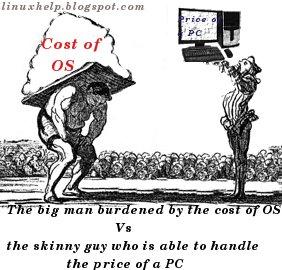 But when it comes to developing a software or OS for that matter, none of the above rules hold true precisely because an OS is intangible by nature. It is possible to distribute the OS to 10s, 1000s, millions or billions of people and still the creators of the OS will have the original OS with them. The logistical problems are a bare minimum for the simple reason that the OS can be distributed via electronic medium such as the Internet. And if they are providing boxed versions, it takes up much less floor space than computers.
Yes efforts and costs are involved in creating a robust OS. But once the main coding is done and finished, the further costs incurred by the OS company is mostly on marketing, bug fixing and in adding new features. For instance, of the reportedly 57,000 strong employees working at Microsoft world wide, a large percentage of them do jobs related to marketing.
This obvious mismatch in pricing of proprietary OSes is precisely one of the reasons that GPLed OSes are increasingly gaining favor among the computer users. The ideological factors apart, it doesn't cost an arm and a leg to acquire GNU/Linux even if you opt for one of the numerous GNU/Linux distributions which are sold for money. And the fast paced advances of the various projects developed to run on this OS (Gnome, KDE, Wordprocessors, Web Browsers, Graphic editors.....) make sure that the end user is not left wanting in his computing needs.
So the next time your hands start itching to buy the latest state of the art proprietary OS , ask yourselves this question. Is the mismatched price of the OS justified ? And what are the other avenues one has which gives more or less the same user experience without lightening your wallet by any measure?
Monday, 14 August 2006
Is the word Ubuntu in "Ubuntu Linux" over-hyped ? Decide for yourselves.
 Recently I read an article lambasting or rather dissecting the role that Ubuntu has played in the Linux community and according to the author of the article titled - Ubuntu vs. Debian: What Canonical Doesn't Want You To Know , it boils down to clever marketing on the part of Ubuntu folks or in other words marketing gimmicks. In fact I see this growing dissent towards this distribution in different quarters - mind you, not from the actual users of Ubuntu who love this distribution but from people who are affiliated with or use other Linux distributions.
So as a long time Ubuntu user, I asked myself this very important question. Is the Ubuntu word over-hyped ? Is Ubuntu Linux riding on the wave of good will, on top of what this word actually mean ? And finally what makes Ubuntu Linux stand apart from the rest of the Linux distributions ?
Ubuntu is a word in a South African language (Bantu) which has lots of meanings associated with it. And this word originated long before the birth of Linux. When the South African space tourist Mark Shuttleworth adopted this word for his Linux distribution, the word came to be synonymous with the Linux distribution and it gained world wide popularity.
I believe the word Ubuntu has gained as much popularity from being associated with this Linux distribution as the Linux distribution has gained from the word. In other words it is a symbiotic relationship as far as the Ubuntu word and Ubuntu Linux are concerned.
Even though I have been using Ubuntu as my main Linux distribution, I have used and still use other Linux distributions too. If you look around this site, you will find reviews of different Linux distributions as varied as PCLinuxOS, DSL, Vector Linux, Gentoo .... why just Linux, I have also reviewed a couple of non-Linux OSes such as FreeBSD and PCBSD. So my intention in raising this sensitive topic is not as much as to throw dirt at other Linux distributions rather to see why Ubuntu Linux has gained so much popularity and if it is worthy of it.
The number one incentive for me to try out Ubuntu in the first place (earlier I used to be a Fedora user) was that they were shipping (still do) free CDs of Ubuntu Linux to anyone around the world. This at a time when I had to do entirely with dial-up connection to log on to the net. Even now, in most third world countries, the word broadband Internet is synonymous with just 256 Kpbs speed and many people do not even have this luxury. So the vision of Mark Shuttleworth to hand out free CDs of Ubuntu to anybody who asked for it became a major hit world wide. In fact by doing so he made Linux free not only as in freedom but free as in beer too.
But handing out free Cds alone will not bring as much popularity as it now enjoys. After all if that were the case, all software (proprietary or otherwise) which we receive free of cost would have been as popular. So there are more reasons...
Any long time Linux user will agree with me that Debian holds a special place in their hearts. It has the largest number of packages in its repository than any Linux distribution can boast off. It is stable and can be compared at par with other Unices in its uptime. But one area where Debian developers lagged behind was in creating a separate Linux distribution or should I say a separate entity which the ordinary user could easily install and use on his desktop. Debian was and is more server oriented. I had the fortune of installing Debian on my machine a couple of months back. Even though I was able to successfully install, use and enjoy it, I had to struggle a bit in figuring out how to install it. The installation is far from newbie friendly. I would go so far as to say I found installing FreeBSD to be much more simpler than installing Debian. This is one area where the Debian developers have to direct their efforts to. And I believe something is being done to address this shortcoming. But that is not all, since it is a Linux distribution oriented to be run first and foremost on the servers, it comes with a lot of additional packages which a normal user will not have a clue as whether to install or not. So some one who needed a newbie friendly Linux distribution based on Debian had to put up with trying out Knoppix Live CD.
Ubuntu Linux, I believe addressed this need. They took all the good things that Debian has to offer - its excellent repository of packages, its superior package management, its stability and then took it one step further by fine tuning it to make it newbie friendly by making it possible to install it on to the hard disk by a mere six steps.
If you look closely, Ubuntu has made a number of refinements which make it an ideal OS for the home user. For one, it comes with all the ports closed by default. As a home user who's only interaction with the Internet is web browsing, checking mails and playing a few online games, the last thing I need are unnecessary services running on my machine. And Ubuntu Desktop has made it possible. As a comparison, I found a default Fedora desktop installation to run more than 10 services including Avahi (what ever that means). And in Ubuntu the only service listening on the tcp/udp ports is the cups printing service. Run the following command to see all the services that are listening on your tcp and udp ports to get an idea.
$ netstat -taupOr better still, run nmap to find the open ports on your machine running your favourite Linux distribution and then see how many are open in Ubuntu.
# nmap -sS <your machine IP address>Ubuntu Desktop does not ship with even a compiler. So it is impossible for a person who has access to your machine to write some malicious code, compile it and then make it to run during startup, in the process compromising your machine.
And for those who want such facilities as a compiler and ssh daemon running on your machine, it is a simple case of using apt-get to download and install the necessary packages in which case you are expected to know what you are doing and its consequences.
The point I wish to make is that Ubuntu team has been successful in addressing the need for a truly user friendly secure Linux desktop that the other major players failed to address. And the potential Linux users were quick to grab at what was offered and then form a community around it.
And while on the topic of community, One of the biggest strengths that any Linux distribution can aspire for is a large user community revolving around it. It is the community which imparts life to any Linux distribution and it aids in spreading the word about the distribution. And Ubuntu has been a success on this front. This might bring up a question in someones mind. Can a community be brought ? Not at all. It is something that happens when passion is involved. If not for passion, why then would some people spend many man hours developing scripts such as Automatix or EasyUbuntu and then share it freely with the rest of the Ubuntu users ? Why would anyone go out of their way to help in getting some things working right in Ubuntu ? Are these people on the payrolls of Ubuntu? No. It all filters down to passion. And passion my friend, cannot be brought. It is something that comes from within. In my opinion, Ubuntu has taken all the right steps in stirring this passion in its users which is why it enjoys an ever growing community.
That doesn't mean Debian doesn't have a strong community following. But the community revolving around Debian consists of an entirely different set of users. That is those who are more system administrators than ordinary users. And it is anybody's guess that normal users far out number the system administrators. I myself am a fan of Debian and I am sure that any day they bring out a newbie friendly distribution at par with what Ubuntu is now, a community will form around it and start promoting it.
Lastly, by choosing to use the packages in Debian Sid, Ubuntu has made sure that its users enjoy the latest versions of the software they have grown to love. I may also add that the hardware detection of Ubuntu is above par and is known to detect the widest range of hardware out of the box.
To sum up, these are the factors that has catapulted Ubuntu as the number one Linux distribution in terms of popularity. They are as follows:
- Distributing free Ubuntu CDs to anybody who asks for it.
- Designed with the home user in mind.
- Excellent hardware detection - a quality I believe is shared by other Linux distributions.
- A strong user community backing its growth.
- Containing the latest versions of the software packages.
- Managing to grab the average user's imagination with its association with the Bantu word Ubuntu.
Update (Aug 16 2006): My intention of writing this article was not to disparage any Linux distribution be it Debian, Fedora, SuSE or any other which I am sure enjoy its right place in the Linux community. But I strongly believe that if any Linux distribution has to excite the passion in the general public in the same level as Ubuntu has then they should discard this one size fits all principle. Which means they should delink the distribution for the ordinary masses from that for running on the servers. I believe that if these main stream (and other) linux distributions take a leaf from Ubuntu and bring out a truly newbie friendly distribution - sans sshd and other unnecessary services and without the compilers and such, I am sure they will be well recieved by the common public (average joes) who wish to run Linux on their machines.
Tuesday, 18 July 2006
Realising the true value of Freedom
Anybody who keep an eye on the happenings around the world would know by now that the Indian Government, in its drive to curtail and restrict anti-national elements from playing havoc have passed orders to all ISPs in the country to ban 22 sites which post volatile material and spread hatred. This comes in the aftermath of the dreadful bomb attack on a couple of suburban trains in Mumbai - the financial capital of India, which led to 100s of innocent people dying and many more getting injured. My heart goes out to the kith and kin who lost their loved ones.
The ISPs in their national zeal have taken the easy way out (according to a report in today's edition of a leading newspaper) and block whole domains. And blogspot.com, the domain which hosts this site is also included. The end result is, no body inside India can access this or any of the blocked sites directly.
And the fact that I cannot view my own blog brought some discomfort to me initially. But I love my country and if blocking a blog domain will restrict the anti-national elements from using it to communicate with each other and stop the spread of terror, then I am all for it and I am willing to put up with the discomfort. After all, the existence of a blog or a site pales when compared to the threat posed to the lives of innocent people.
But this situation set me thinking. Generally, people are not aware of the value of their freedom and take it for granted. It is only when some adverse situation arises and the powers that be decide to restrict the rights enjoyed by us that we start missing them and then we realise how much that particular freedom meant for us.
For example, people in the US of A enjoy a wide degree of freedom. But how many of them really value their freedom ? I guess not many because they take it for granted. It is only when they are on the verge of losing some of their freedom that they become aware of the significant part it plays in their lives.
Similarly, people in China are born and brought up in a society where the government has placed various restrictions. The Chinese will find it normal to live in their country because they have not enjoyed the freedom in the first place and so, will not be aware of what they are missing.
It is only when you enjoy a right and then that right is suddenly taken away from you that you start to realise how much it contributes to your well being.
On a similar vein, many people who use free software including GNU/Linux take it for granted and do not even think twice about supporting the software they enjoy using. But suppose tomorrow, the rule of law passes a decree that using GPLed free software is against the law and prohibits the sharing of free software including GNU/Linux distributions. This is when people who use GNU/Linux and free software will find out how much they have gained from this movement and then, people will start to realise the true meaning of the word 'Free' in 'Free Software' and associate it with the word 'Freedom'. Until then, a major section of people using free software will be more concerned about the price factor.
Update (July 21st 2006): With the blanket ban on blogging domains making news world wide and casting a shadow on the government, an official directive was sent to all ISPs to lift the blanket ban on the blogging domains. But the ban on the 22 or so sites will remain. So now all in India can access blogspot.com domains. This is surely democracy at work. I doubt this would have been possible in a more restrictive society. On another note, I believe we can learn something from this whole affair. That is one should not take ones freedom for granted. Rather, each one of us have a duty towards the society we live in which earns us the right of freedom.
Friday, 19 May 2006
Mac OSX - Should it use the Linux Kernel ?
A couple of days back, in a news article titled - Monolithic Kernel vs Micro kernel - published on this blog, I had described the intense debate on this between two school of thoughts fueled by Linus Torvalds and professor Andrew.S.Tanenbaum. One of the examples Andy had given as proof of the stability of micro kernel architecture was the popular Mac OSX itself which (according to Andy) runs on top of the Mach kernel which follows the micro-kernel architecture.
Now it is well known that the Mach micro-kernel, from its inception has been ridden with problems both design wise as well as in performance. So there are many people who wonder why Apple still uses the mach kernel with all its design flaws. In fact there is a group in the Apple community who favor transferring OSX to run on top of the Linux kernel instead which by the way is a monolithic kernel.
Daniel Eran has written an interesting article debunking the popular belief that Mac OSX is based on a micro-kernel architecture and goes on to explain that Apple's kernel named XNU kernel is not implemented as a micro-kernel. In fact, he is of the opinion that the original Mach kernel on which OSX is based on is a fat kernel and it was the Mach micro-kernel project which was a failure.
My Opinion
We are not short of robust kernels be it the BSD kernel, Linux or any other. In fact the beauty of the POSIX environment is that one can switch one kernel for the other and with a little effort still build a stable and secure OS which is what makes this OS design of separating the OS kernel from the userland tools such an exciting proposition.
Saturday, 8 April 2006
My Indomitable Thoughts on GNU, Linux, Open Source, Java and Free Cats and Dogs
 Recently, when I ran a transcript of a talk given by Richard Stallman at the Australian National University, I never expected to get any adverse remarks about him and on the views expressed by him on problems faced by the free software community. But that was not to be. I was appalled to find a lot of comments ridiculing RMS for the views aired by him on various sensitive topics.
In fact, the sheer number of these negative comments make me feel that these were made not by free software users but by people who have a stake in proprietary software and they were making these comments posing as GNU users to spread FUD among potential free software converts. In real life, I have yet to come across a person who finds use for free software and who hold negative views about the leaders who made this possible. And if somebody does that, I would call it crass opportunism. RMS, Linus Torvalds, Bruce Perens, Alan Cox and many others have made great contribution in the evolution of GNU and open source movement to its present form.
But let us analyse what RMS said in his talk. His comment that Linus was apolitical when taken within the larger context of his appeal to give GNU equal credit makes perfect sense. Linus has himself gone on record saying that he hates playing politics and would like his software to speak for itself. In fact, Linus Torvalds and RMS think in entirely different planes. When the former likes to limit himself to the technical aspects of the free software , the latter thrives more in the political plane. But by doing so, they both play a very significant role in the betterment of the free software community. While Linus works to improve the Linux kernel making it more robust, RMS acts more like a watch dog for the free software community. He keeps track of the changes wrought by the powerful proprietary lobby and cries wolf when he sees one - like changes in laws which threaten one's freedom.
And much of what RMS said in his talk makes perfect sense. Take java for instance. Presently, Sun has a major say in shaping the future of Java language. It has not released the the implementation libraries under an open licence be it GPL or open source. Now there would have been no cause for concern if things remain the same even in the future. But what happens in 10 or 15 years from now, in the advent when Sun finds it difficult to stay afloat and gets acquired by say Microsoft ? Corporate acquisitions happen all the time. If an Adobe can acquire its arch rival Macromedia, what is stopping Microsoft from getting a controlling stake in Sun Microsystems? Will the language Java remain the same as it is now? Will the programs created in Java continue to run on Linux as it does now? For any language to thrive, it should be open and no single corporation should have a dominant say in chalking out its direction. And for Java to be really free, it has to be immune to corporate acquisitions. When you take this into consideration, what RMS said about Java not being truly free makes perfect sense.
The proprietary software lobby consider GNU as their arch enemy. If the free software movement gets adopted by the masses, then that will spell the death-knell for many of the non-free software firms as there won't be a market for their products. So they utilize every opportunity to attack the moves made by GNU and open source group.
When RMS talks about Treacherous Computing, we'd better sit up and take notice. Just going through the list of computer models with in-built treacherous computing chip should give a broad idea of the extent to which this has creeped into our lives. True, DRM is just a technology and the technology in itself is not bad. But the ways in which this technology is put to use by the corporations to stifle ones freedom is what prompts leaders like RMS to rally against this technology.
I believe GNU and open source to be the two sides of the same coin. Where open source has proved itself as a successful business model, GNU has remained stead fast in safeguarding the freedom of its users. Open source needs the strength of GNU ideology to maintain its focus in providing robust software and GNU in turn will benefit from the large collection of open source software under its fold. And it will be in the larger interests of the freedom loving users if open source and GNU sink their minor differences and act in synergy with each other.
It is a common misconception that free software stands for free as in free cats and dogs. That is not true. GNU doesn't say that one cannot sell or make money off the software one releases under GPL. Only that one has to make available the source code of the program to the user on demand. When you think about it, to even move an atom or molecule, one has to expend energy. And it is fundamentally wrong to expect some thing free of cost. Because what you got for free, another would have slogged to create it and you are actually enjoying the fruits of another person.
So the big question is how does one pay for the free software one uses? Interestingly, money is only one form of payment. There are other forms of payment like doing a favor in return for the convenience of your freedom. For example, one can spread the word about free software and open source. One can hand out CDs of GNU/Linux to ones friends, colleagues and relatives and persuade them to use it. I believe that by writing about free software on this blog, I am paying back to the free software community for the excellent software that I use.
Free software and open source have advanced so much that money has become a minor issue for it.Take the case of Wikipedia - the open and free encyclopedia which anyone can edit. When they were in need of funds, money started pouring in from all quarters and they were able to raise over 100,000 US dollars in a matter of weeks. What the GNU movement desperately need to make further inroads into the desktop market is more publicity and awareness which, as a user of free software, each one of us can provide. And if each one of us take it upon us to spread the word, I believe it will make a marked difference.
So the big question is how does one pay for the free software one uses? Interestingly, money is only one form of payment. There are other forms of payment like doing a favor in return for the convenience of your freedom. For example, one can spread the word about free software and open source. One can hand out CDs of GNU/Linux to ones friends, colleagues and relatives and persuade them to use it. I believe that by writing about free software on this blog, I am paying back to the free software community for the excellent software that I use.
Free software and open source have advanced so much that money has become a minor issue for it.Take the case of Wikipedia - the open and free encyclopedia which anyone can edit. When they were in need of funds, money started pouring in from all quarters and they were able to raise over 100,000 US dollars in a matter of weeks. What the GNU movement desperately need to make further inroads into the desktop market is more publicity and awareness which, as a user of free software, each one of us can provide. And if each one of us take it upon us to spread the word, I believe it will make a marked difference.
Monday, 19 December 2005
The best Linux distribution of them all - an Epilogue
I had written a previous post named - The best Linux distribution of them all - where I tried to explain in the best possible way, how to go about selecting a Linux distribution. The response to that post was overwhelming and so many people added a comment which gave valuable insights about their favourite distribution that it became impossible to publish all the comments without making the page lengthy. So instead of publishing all the comments, I decided to write a separate post giving the gist of what everybody who read the post had to say. Also I wanted to clarify a few things that I had left out in the original post.
First and foremost, the staff writer at madpenguin.org, Mr Christian Einfeldt was kind enough to drop by and share his views about this very volatile topic. In a nutshell, This is what he had to say:
All the newbies out there could get themselves a Live CD with an instruction manual. He gave three choices of books them being :
- "Linux Made Easy" by Rickford Grant, which comes with a free copy of Xandros Open Circulation edition of Linux.
- "Point & Click Linux" by Robin Miller, which comes with a copy of Mepis Linux." and
- "Peter van der Linden's Guide to Linux," which comes with a Linspire Live CD in it.
... the reviews of which you can read at madpenguin.org. Thank you Mr Christian Einfeldt for sharing your thoughts on this subject.
A surprising number of people said they used PCLinuxOS or Mepis as their choice Linux distribution and they vouched that these supported all proprietary file formats out of the box.
A number of people voted for Arch Linux and still others for Vector Linux which is based on Slackware.
A few of the comments pointed out to me that Mandriva indeed supported mp3 file support out of the box which was a little known fact.
I had written that Debian was the only linux distribution which supported the maximum architectures. But then this is what one commenter had to say about it - "Both Red Hat and SuSE also have support for non-Intel platforms, like IBM's zSeries mainframes. Debian certainly isn't the only one".
A reason I left out saying anything about liveCDs was because all linux distributions worth their name have released a live CD. More over, all live CDs work out of the box with support for all file formats. Another thing is a liveCD is designed to be booted from the CDROM and is not optimised for installing on the hard disk.
Finally, I have a statement to make. I am in no way affiliated with any linux distribution or any commercial website. And nobody has paid me to give preference to their linux distribution in my post. Further more, what ever I have written is my own opinion.
Wednesday, 14 December 2005
The Best Linux Distribution of them all
A few weeks back, my friend Tom asked me a question regarding Linux - that is - Which is the best Linux distribution of them all. And following is the lively conversation we had about this topic which I am sharing with you.
Tom: Ravi, There is a lot of talk going on about Linux which I have read in websites, newspapers and articles in magazines. I am aware of quite a few names floating around like debian, ubuntu, fedora and so on. Which Linux distribution according to you would be the best one around ?
Me: Tom, you have asked a really simple question which has no single/simple answer. But I will try and explain it as best as I can. You should know that Linux is just a kernel. When all the necessary tools like the word processors, image editors, compilers and likes are added so that they seamlessly work on top of the Linux kernel, it becomes a distribution. I need not tell you that different people have different likes and dislikes. With respect to computers and OSes too this holds true. The versatility of Linux is that there is a Linux distribution which commits to cater to individual likes.
Tom: I didn't get you. Could you explain it a little bit more clearly ?
Me: Sure. You see, people can be categorised according to their tastes in computing. For example, one person may be newbie who is just getting introduced to computers who expects some hand holding. Another may be a Linux Guru who likes to do all his work using command line utilities. The beauty of Linux (or should I say the GNU movement) is that there is a distribution tailor made for each of these people.
Tom: So you are saying that the correct answer to my question is that it depends on the individual. Right?
Me: You are bang on target when you say that. :)
Lets look at a few scenarios. Suppose you are a student of computer science. Your main motive in installing Linux on your machine would be to study the inner working of the OS. About what happens under the hood of the OS so to speak. A person with such an inclination will find it ideal to build your own Linux distribution compiling from source. In fact, there is a project called Linux From Scratch which precisely lets one build a Linux distribution grounds up. Another distribution which caters to this segment of people could be Gentoo.
Tom: Well not all people are computer science students. How about a newbie like me ?
Me: For new users like you (and there are quite a lot of them too), there are Linux distributions which come bundled with nice GUI front-ends which makes your Linux experience really enjoyable.
But before we go into it, I would like to say something. Linux distributions can be broadly classified according to the package management they support. Package manager is a program similar to a setup installer in windows. There are two main players in this arena. One is deb package, the other being rpm (short for Redhat Package Manager).
Most Linux distributions follow one or the other of the above said package format to install applications. For example, Linux distributions like Debian and Ubuntu follow the 'deb' package format where as Redhat, Mandriva, SuSe and the likes follow the 'rpm' format.
But before we go into it, I would like to say something. Linux distributions can be broadly classified according to the package management they support. Package manager is a program similar to a setup installer in windows. There are two main players in this arena. One is deb package, the other being rpm (short for Redhat Package Manager).
Most Linux distributions follow one or the other of the above said package format to install applications. For example, Linux distributions like Debian and Ubuntu follow the 'deb' package format where as Redhat, Mandriva, SuSe and the likes follow the 'rpm' format.
Coming back to your question, a newbie will feel right at home in installing and using any of the distributions like Ubuntu, Fedora, Debian and so on. But there is an important factor. Because of licensing restrictions, these distributions exclude support for popular file formats like Mp3, Quicktime, wmv (windows media player), viewing encrypted DVDs and so on.
Tom: What? You mean, I would not be able to play my favourite mp3 music on these distributions ?
Me: Not at all. All I implied was that you have to download the codecs and install it by yourselves if you want the support for these file formats. For example, I use a versatile media player called mplayer to view all my mp3 audio and video. And it works flawlessly.
Tom: Is there a distribution that has these codecs installed by default ?
Me: Of course there are. For example, distributions like Linspire and Xandros comes with support for these formats. But you will have to shell out some money and buy first in order to use them.
Tom: What if I wanted to use Linux as a server ?
Me: If you are exclusively using Linux on the server side, then the GUI will lose its significance. You will be better off trying Debian. This Linux distribution gives stress on security and is considered to enjoy a large share of the Linux server market. Of course, you can also try RedHat or SuSe for the same. But the situation at your work place also play an important role in selecting a distribution for the server.
Did you know, Debian is the only Linux distribution that supports architectures other than x86/IA32, Intel 64 bit, AMD 64 bit and PowerPC ? More over, Debian is not controlled by any corporation or single entity and it is maintained exclusively through donations and volunteer support.
Did you know, Debian is the only Linux distribution that supports architectures other than x86/IA32, Intel 64 bit, AMD 64 bit and PowerPC ? More over, Debian is not controlled by any corporation or single entity and it is maintained exclusively through donations and volunteer support.
Tom: Ravi, you know Manish, my friend from school days ? He tried installing SuSe on a Pentium II machine with 32 MB RAM. And he said that he ran into problems in running GUI applications.
Me: That is because he doesn't have enough memory to run GUI applications. Anyway, SuSe is targeted at more recent machines having at least 128 MB RAM. But tell him he need not despair. There are Linux distributions which cater to this segment too. Like you have the Damn Small Linux which runs easily even on machines with just 32 MB memory. Did you know that Damn small Linux takes up only 50 MB space on your harddisk in its uncompressed state? Another linux distribution in this category is Puppy Linux.
Tom: Really? I wonder how they accomplish this extraordinary feat.
Me: If you are impressed by that, then there are Linux distributions that fit inside a floppy.
Tom: No Kidding ?
Me: Seriously Tom. I am not pulling your leg. Tombsrtbt is a Linux distribution that fits inside a single floppy. It can be used for troubleshooting purposes.
Tom: And it has my name too ;) . But seriously how is all this possible ? It is a bit overwhelming to have this discussion itself.
Me: All these forks are possible because of the GNU movement. If Linux was released as a closed source project, these forks would not have seen the light of day.
Tom: I am just curious. Which distribution will a geek favour ?
Me: Heh heh, So you are aspiring to be a geek is it ? I have heard that Slackware and Gentoo are favoured by geeks. Slackware needs some mention here. It is one of the oldest distribution around. Earlier I talked about Deb and RPM formats. But Slackware uses an entirely different format called TGZ - which is gzipped tape archive, to install applications. There are many die hard slackware users who swear by this distribution for its ease of configuration and use. But it is not suitable for new users because most of the configuration is done by editing text files.
Tom: But I always hear of Fedora, Ubuntu and the likes but seldom do I hear about Slackware, Xandros, CentOs or any others. Why is that ?
Me: Tom, you have to understand that somebody who makes the loudest noise need not always be right. Firms like RedHat and Novell (SuSe) are multinational corporations which have millions of $ at their disposal. They gain all the publicity by running advertisements, conducting certifications and so on. Then there are some distributions like Debian and Ubuntu which grab the public's fancy because of their social ideals and commitment towards GNU movement and essentially because they are free as in freedom as well as beer. That doesn't mean they are the only good distributions around. Ultimately the choice filters down to the ideals, tastes and necessities of the user.
Tom: Going by our discussion, I have arrived at the conclusion that I want a Linux distribution which is easy to install, easy for newbies and support all proprietary file formats out of the box (I definitely want to hear mp3 music). It has to have good customer support. And I am willing to pay money for it (though within limits). I guess I will go for Xandros, Mepis or Linspire. What do you think ?
Me: Go for it Tom. I have always known that you have a penchant for spreading your money around ;) . But on a serious note, I think you have taken a good decision because when you pay money for the distribution, they include addons like support for propritery file formats and the user is saved from the job of installing them himself. Some of these distributions like Linspire also ship with non-free softwares like Win4Lin which helps you to run popular windows programs like photoshop and games like Age of Empire. So it is money well spent. It may be worthwhile if you visit Distrowatch.com and read some reviews about what people have to say regarding a particular distribution before you make the choice.
Tom: Ravi, thanks for clearing my doubts regarding the Linux distributions. This discussion has helped me a lot. I do not know what I would have done without friends like you.
Me: No problem Tom. And God speed ahead.
A note to Readers
Tom and Manish are fictitious characters and this whole train of thought took place inside my mind. I hope this conversation has helped clear the air about which Linux distribution is ideal for you.
Saturday, 5 November 2005
5 Point program to beat the Mac
I have been thinking lately, why Apple is so successful in selling its products ? It is so successful that Apple's stock has risen from $14 a few years ago to $59 at present.Is it because it has a superior OS ? No. Its OSX is only as stable and secure as the Unix base on which it is built. Apple is successful in selling their products because they bring out aesthetic looking beautifully designed products. The keyword here is beauty. It helps that the underlying OS is stable too.
Humans have always been attracted by beauty - either in others or in the things around them. I shudder to think of what would have happened if God had created a plain looking Eve instead of the beauty she was. Adam would not have taken any interest in her and that would have been the end of the human race. Heck! God would have had to start all over again (just kidding).
But seriously, if you keep a PC and a Mac side by side and ask a kid to choose one from the other, I will bet my shirt that the kid will choose the Mac over the PC. Is it because he realizes that OSX is better? No. He takes his decision based on the beauty of the products.
Why do you think there is such interest generated on the iPod ? Is it because the music you get on an iPod is cheaper ? Or is it because there are no such devices brought out by other firms ? No. People go crazy for the iPod because it is a well designed beautifully crafted piece which has flaunting potential. You just flash an iPod around a group of strangers and you are guaranteed to start a conversation.
I wouldn't keep the PC in its current form in my drawing room along with my TV. I would rather that it be kept in my bedroom away from the prying eyes. But a Mac can easily find its place in my drawing room. When it is not being used as a computer, it acts as a piece of art.
So I have put together this 5 point agenda for PC manufacturers which is a sure shot Mac killer.
- Hire a good Design consultant : I am saying this to all the Dells and HPs of this world. Be serious about this guys, if the PC has to compete with the Mac, it should have appeal. With the money you make, you can easily afford the services of a design expert. Design a PC which is as beautiful if not more than a Mac.
- Reduce the form factor of the PC - The PC in its current form is a 10 KG gorilla which requires a hefty adult to move it around. By reducing the form factor, the PC can shed its excess weight and will take up less space which will be appealing to the customers.
- Use hardware parts which has drivers readily available - Make sure the hardware you use in the PC you build have driver support available for all OSes including Linux (Why Linux? read on... you will know soon).
- Use cutting edge technology - The PC should have enough interfaces like USB,Firewire, Gigabit Ethernet ports built-in to it and should be WiFi enabled. If someone can bring out a $100 laptop, with these technologies built in, I wonder what is stopping you.
- Preload Linux on all your PCs. You can save a lot of money in OS licenses and can even market the PC at a lower cost than the competition out there by deciding to use Linux. If you ask me, I can do everything and more in Linux that I can do on a Mac. Linux has come of age.
Think about it, just two countries, India and China combined, has a population of over 2 billion. Out of this only a tiny fraction of its people own a computer. Which means there is a huge market potential for selling computers in these countries. Just by bringing out a computer of the above specs and preloaded with Linux and priced economically, you can conquer this still untapped market of epic proportions.
If the five points stated above were followed by any hardware manufacturer, I see no chance of the Mac making a killing in the computer market..., unless Apple decides to give out OSX for free with the hardware it sells. Remember, they are moving on to the Intel platform in 2006.
Clarification: After I wrote this post, I have been getting quite a few mails I think are from apple fan boys ;-). So I would like to make my stand clear.
- I am no Mac hater. In fact if you read what I wrote just before the 5 points, you will see that I have indeed praised Apple in my own way for bringing such beautiful products.
- The 5 points were targeted at PC manufacturers and not at customers. There is a void felt in the PC arena because the customer is faced with buying PCs which do not look good when compared to a Mac. But once Apple makes the move to Intel platform in 2006, this void will be filled and by that time if the PC manufacturers are found sleeping, then the customer will make the intelligent choice of embracing a Mac.
- And lastly, my comment on installing Linux on the PC was because not all people will be able to afford a Mac. At least not in the current price range. And I think embracing Linux will help the manufacturers to price their product in a affordable range.
Subscribe to:
Posts (Atom)